







































































































































































































































































































































































































































































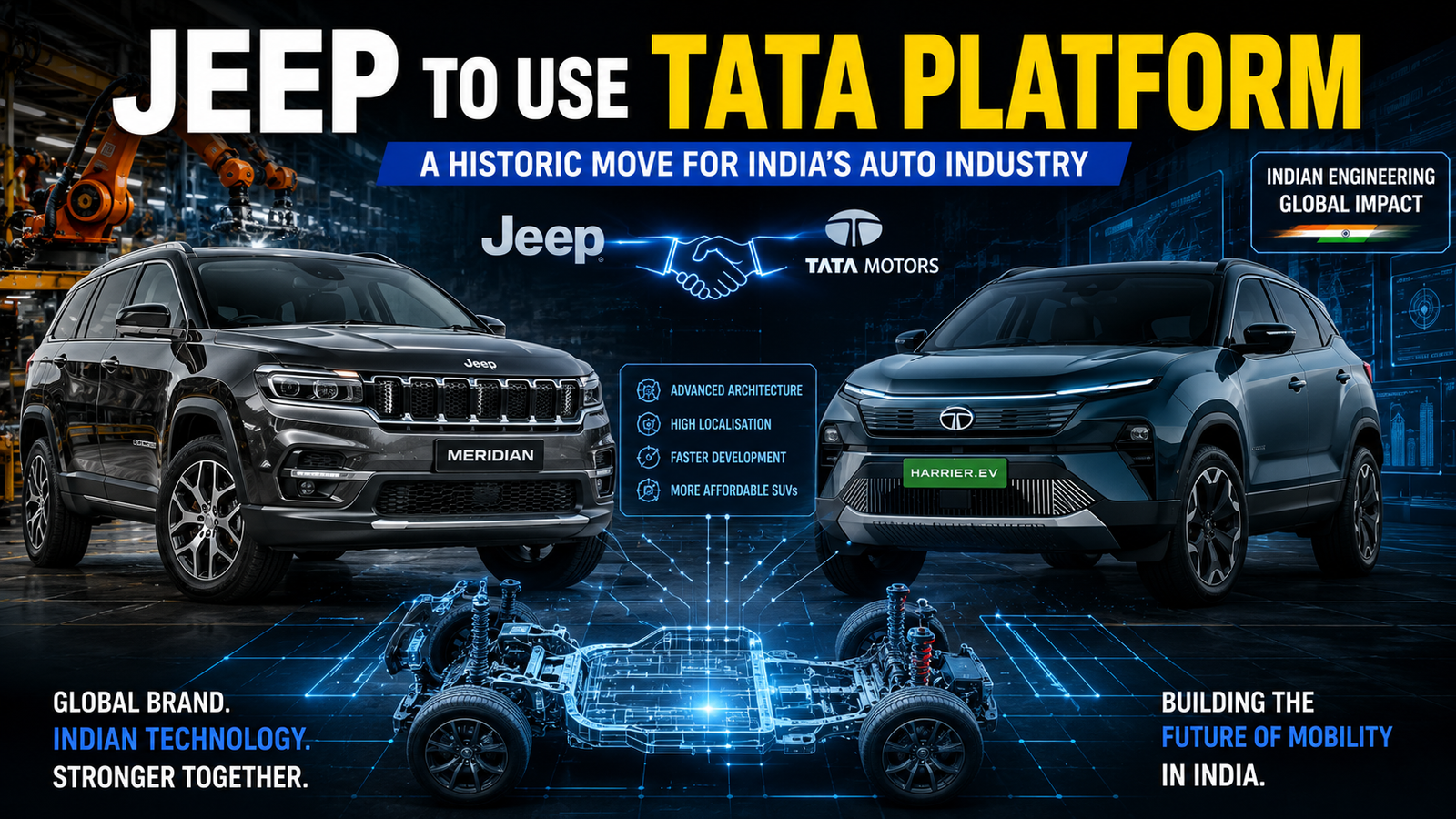
🚗 In what could become one of the biggest automotive developments in recent years, Jeep has confirmed that its future products for India will be built on a platform developed by Tata Motors. While platform sharing is common in the global auto industry, this particular move carries far greater significance than it may initially appear.
For decades, India’s automotive sector largely relied on technology and vehicle architectures developed by international manufacturers. Global brands would design platforms overseas, while Indian operations adapted them for local requirements. Now, the trend is reversing.
🌍 For the first time, one of the world’s most iconic SUV brands is preparing to use an architecture engineered by an Indian automaker as the foundation for future products.
🚙 Why This Is Big News For Jeep
Jeep has struggled to achieve large sales volumes in India despite having respected products such as the Jeep Compass and Jeep Meridian.
Developing an entirely new vehicle platform requires billions of rupees in investment and years of engineering work. By using Tata Motors’ architecture, Jeep can:
✅ Reduce development costs
✅ Increase localization levels
✅ Launch products faster
✅ Offer more competitive pricing
✅ Reach a wider customer base
This could finally allow Jeep to enter price segments that were previously difficult for the brand to target.
🇮🇳 Tata Motors May Be The Bigger Winner
While Jeep gains a cost advantage, many industry experts believe Tata Motors stands to benefit even more from this partnership.
Modern vehicle platforms are among the most valuable assets in the automotive world. Developing one requires extensive engineering expertise, safety validation, software integration, crash testing, and future-proofing for regulations and electrification.
🏆 When a global brand like Jeep chooses an Indian-developed architecture, it serves as a major endorsement of Tata Motors’ engineering capabilities.
The move effectively signals that Indian automotive engineering is now capable of meeting global standards and supporting international brands.
📈 A Milestone For India’s Auto Industry
This development reflects the rapid transformation of India’s automotive ecosystem.
Indian manufacturers are no longer focused solely on building affordable cars for domestic buyers. They are increasingly creating technologies, vehicle platforms, software systems, and electric vehicle architectures that can compete globally.
🔧 What was once a market that imported technology is gradually becoming a source of technology for global automotive companies.
🚘 What It Means For Customers
For Indian buyers, the partnership could lead to:
⭐ More affordable Jeep SUVs
⭐ Better localization and lower maintenance costs
⭐ Faster product launches
⭐ Improved availability of spare parts
⭐ Future electric and hybrid offerings tailored for India
Consumers could soon see Jeep models that retain the brand’s global SUV identity while becoming significantly more accessible to Indian customers.
🎯 The Bigger Picture
The Jeep-Tata collaboration is about much more than sharing a platform.
It represents a symbolic shift in the global automotive industry—one where Indian engineering is no longer just adapting foreign technology but helping shape the future products of international brands.
🚀 If successful, this partnership could encourage more global automakers to explore Indian-developed architectures, making it a landmark moment for both Tata Motors and India’s growing automotive capabilities.