





















































































































































































































































































































































































































































China Takes Back Global Supercomputing Leadership
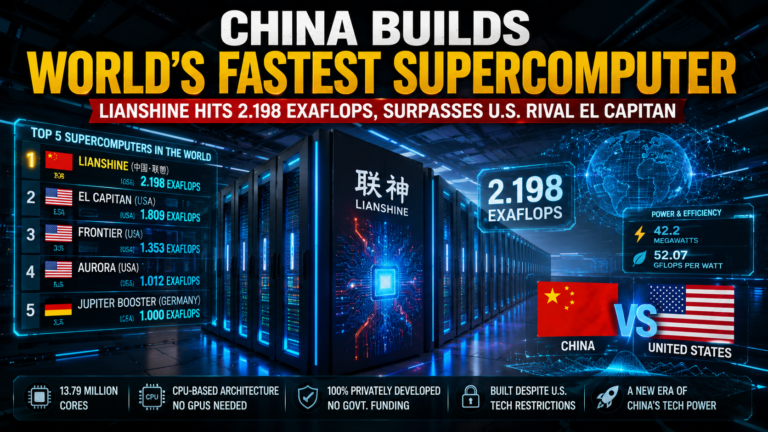
China has officially regained the title of the world’s fastest supercomputer, marking its first return to the top of the global rankings since 2017. The country’s latest high-performance computing system, Lianshine, has surpassed the United States’ El Capitan to become the most powerful supercomputer ever recorded.
According to the latest rankings released by Top500.org, Lianshine achieved a performance of 2.198 exaflops, making it the first supercomputer in history to exceed the 2-exaflop barrier using only central processing units (CPUs).
What Makes Lianshine Special?
Unlike most modern supercomputers that rely heavily on graphics processing units (GPUs) from companies like NVIDIA and AMD, Lianshine follows a unique architecture based entirely on custom-designed Chinese CPUs.
The system is powered by processors featuring 304 cores each and contains approximately 13.79 million processing cores operating at a clock speed of 1.55 GHz.
This achievement is being viewed as a significant technological milestone, especially given the ongoing U.S. restrictions on advanced semiconductor technologies and high-performance computing exports to China.
Performance Breaks Global Records
Lianshine’s performance places it ahead of every other supercomputer currently operating worldwide.
Top 5 Fastest Supercomputers in the World
| Rank | Supercomputer | Country | Performance |
|---|---|---|---|
| 1 | Lianshine | China | 2.198 Exaflops |
| 2 | El Capitan | United States | 1.809 Exaflops |
| 3 | Frontier | United States | 1.353 Exaflops |
| 4 | Aurora | United States | 1.012 Exaflops |
| 5 | Jupiter Booster | Germany | 1.000 Exaflops |
The latest rankings highlight China’s growing capabilities in advanced computing and semiconductor innovation despite global technology restrictions.
Energy Efficient Despite Massive Scale
Operating one of the world’s largest computing systems requires enormous amounts of power.
Lianshine consumes approximately 42.2 megawatts of electricity during operation. However, it delivers an impressive efficiency of 52.07 gigaflops per watt, making it one of the most energy-efficient exascale systems ever developed.
Experts believe this balance between performance and efficiency is one of the machine’s most significant achievements.
Experts Praise China’s Achievement
Renowned computer scientist and Top500 ranking organizer Dr. Jack Dongarra praised the breakthrough, calling the system highly impressive.
According to experts, China’s ability to build a CPU-only exascale machine demonstrates that there are now multiple technological pathways to achieving world-class supercomputing performance.
The achievement also signals that GPU-based architectures no longer hold a monopoly over exascale computing.
Built Without Government Funding
One of the most surprising aspects of the project is its funding model.
Reports indicate that Lianshine was developed entirely through private-sector investment rather than direct government grants. This reportedly allowed developers to submit the machine for international benchmarking and ranking without facing legal or regulatory complications.
However, the company behind the processors and the semiconductor technology used in the system remain undisclosed.
Why Supercomputers Matter
Supercomputers play a critical role in:
- Artificial Intelligence development
- Climate modeling
- Scientific research
- Drug discovery
- National security simulations
- Space exploration
- Advanced manufacturing
As nations compete for leadership in AI and next-generation technologies, supercomputing power is increasingly becoming a strategic asset.
China’s latest achievement is expected to intensify the technological rivalry between Beijing and Washington, particularly in areas related to artificial intelligence and advanced computing infrastructure.