





































































































































































































































































































Alibaba Cloud has officially introduced Qwen-3.5, its next-generation artificial intelligence model family, marking a significant step in the intensifying global AI rivalry between China and the United States 🇨🇳🇺🇸.
The launch, timed just before the Lunar New Year, capped an unusually active week in which almost every major Chinese AI developer rolled out new flagship systems. Two Qwen-3.5 models are now live on Alibaba Cloud’s Model Studio, catering to both open-source users and enterprise customers.
Smaller Model, Stronger Performance
The Qwen-3.5 Open-Source model features 397 billion parameters, yet Alibaba says it outperforms its earlier Qwen-3-Max-Thinking model, which exceeded one trillion parameters. According to Alibaba’s own benchmarks, Qwen-3.5 delivers performance comparable to established systems from OpenAI, Anthropic, and Google DeepMind—though not their very latest releases.
In parallel, Alibaba introduced a closed-source variant called Qwen-3.5-Plus, described as operating at state-of-the-art levels. It boasts a context window of up to 1 million tokens, among the largest currently available, allowing it to process extremely long and complex inputs in a single session.
Native Multimodal AI
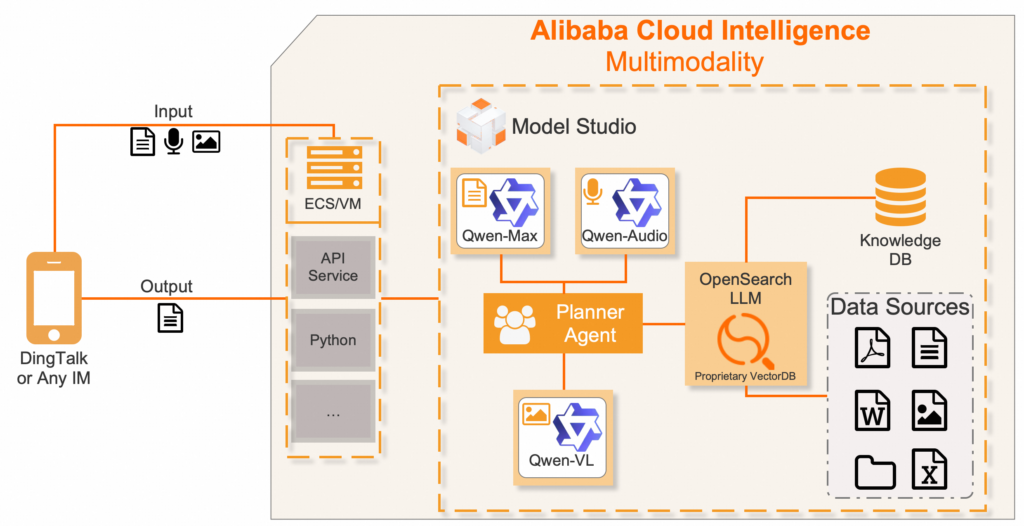
For the first time, Qwen models are built with native multimodal capabilities, enabling a single system to understand and reason across text, images, audio, and video 🎥🖼️🎧. This positions Qwen-3.5 for use cases ranging from enterprise analytics to media processing and real-time applications.
The models also adopt Alibaba’s latest architecture, first previewed in the experimental Qwen3-Next system, which focuses on computational efficiency. Alibaba claims this delivers a new benchmark in performance per unit of inference cost, making large-scale deployment more economical.
Open Weights and Global Reach
Model weights for Qwen-3.5 have been released on Hugging Face and Alibaba’s ModelScope, allowing developers with sufficient hardware to run the models locally. This reinforces China’s growing emphasis on open-source AI, contrasting with the more closed strategies often favoured by Silicon Valley giants.
Download data from Hugging Face shows Chinese models such as DeepSeek and Qwen leading global adoption growth over the past year. Qwen’s popularity is further boosted by Alibaba’s strategy of releasing multiple model sizes to serve startups, enterprises, and researchers alike.
Expanded Language Support
Qwen-3.5 now supports 201 languages and dialects, adding 82 new ones compared with the previous generation. These include lesser-served languages such as Hawaiian and Fijian, strengthening Qwen’s appeal as a globally deployable AI platform .
Open-model experts have increasingly described Qwen as a de facto open-AI standard, citing its scale of adoption and versatility.

Strategic Implications
While downloads highlight popularity, analysts caution that real-world deployment will ultimately determine geopolitical and commercial impact. Alibaba continues to keep its largest “Max” models closed and tightly integrated into its consumer-facing Qwen app, while using open models to drive cloud adoption and AI services worldwide.
Alibaba Cloud’s Qwen technical leadership has also hinted that more open-weight models could be released in the coming days, signalling that the AI race is far from slowing down