




























































































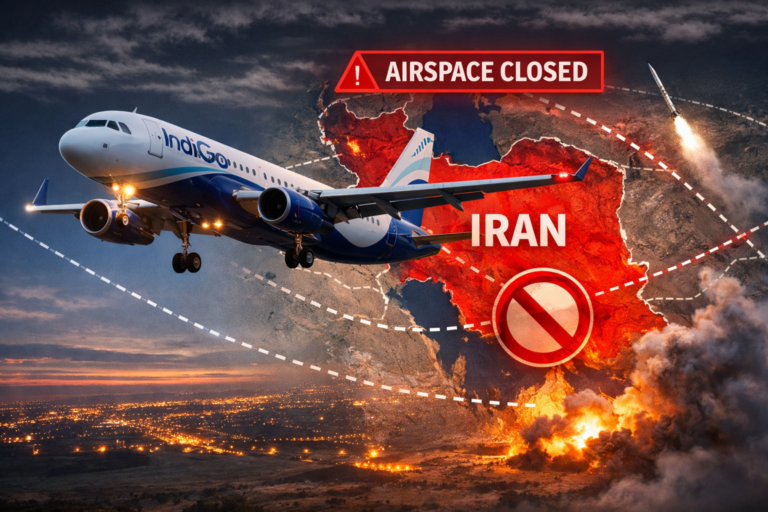



































































































































































































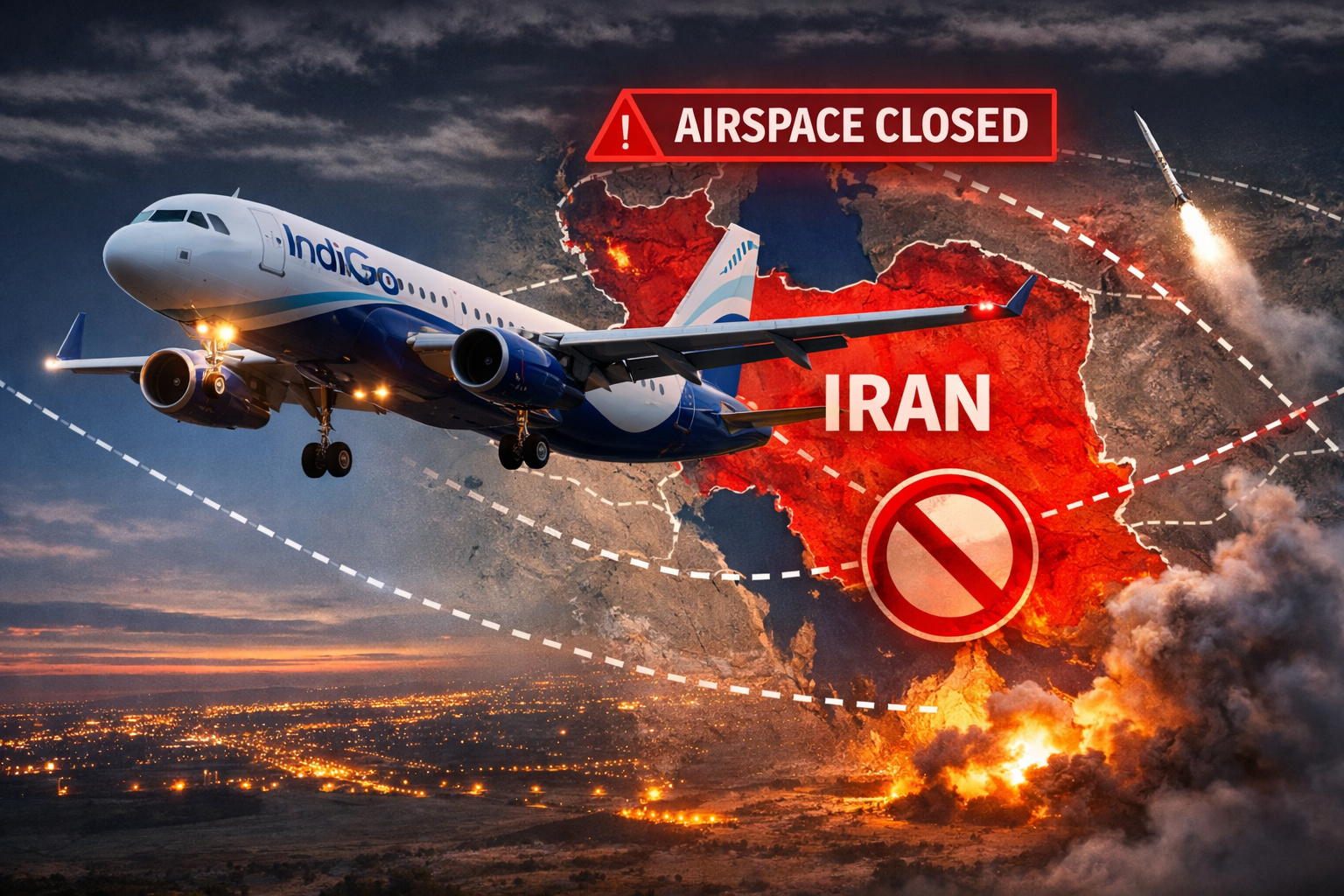
A Delhi-bound IndiGo flight narrowly exited Iranian airspace just minutes before Tehran abruptly closed its skies early Thursday, causing widespread disruption to international flight operations and forcing multiple carriers to reroute or cancel flights.
Flight-tracking data indicates that IndiGo flight 6E1808, operating from Tbilisi, Georgia, to Delhi, was flying over Iranian airspace at approximately 2:35 a.m. local time — just minutes before the Iranian aviation authority issued a Notice to Air Missions (NOTAM) at around 3:00 a.m., shutting down most of the country’s airspace. The aircraft is believed to be the last non-Iranian commercial flight to cross the country’s skies before the closure took effect.
Another IndiGo service from Baku to Delhi was unable to proceed and returned to Azerbaijan’s capital within an hour after takeoff due to the sudden closure.
Sudden Airspace Closure Throws Global Traffic Off Course
Iran’s decision to close its airspace came amid widespread protests against Supreme Leader Ayatollah Ali Khamenei and heightened tensions with the United States, according to aviation analysts. Although there were no confirmed active hostilities at the time of the closure, the move triggered immediate disruption because Iran sits on key east-west global flight routes linking Asia with Europe and North America.
The abrupt closure — which lasted for more than four hours — forced many international carriers to take longer detours over neighboring airspace or suspend services entirely. A limited number of flights with special authorization were permitted to operate during the shutdown.
Iran has previously implemented similar closures during regional conflicts, including during a 12-day war with Israel and exchanges of fire in the Israel-Hamas war last year.
Impact on Indian Airlines
The airspace shutdown significantly affected major Indian carriers:
Air India
Air India reported the cancellation of multiple long-haul services, including:
- Delhi-New York JFK (AI 101)
- Delhi-Newark (AI 105)
- Mumbai-JFK (AI 119)
Return flights on these routes were also cancelled. In a corporate statement, Air India said it was adopting alternate routings “in the interest of passenger safety,” and noted that some flights were being cancelled “where rerouting is currently not feasible.”
IndiGo
IndiGo confirmed that the sudden closure impacted several of its international services and said teams were working to support affected passengers with rebooking and alternative options. “Safety of our passengers and crew remains our top priority,” the airline said.
SpiceJet
SpiceJet also reported disruptions on its international schedules, attributing changes to the temporary blocking of Iranian airspace.
Responses from Global Carriers
Several international airlines such as Lufthansa Group have also been affected. Lufthansa said it was adjusting operations — converting some flights to daytime services through alternative routing between Tel Aviv and Amman until January 19, 2026, and noted that decisions on cancellations would continue to be evaluated.
In addition, Lufthansa and other carriers said they would be circumventing Iranian and Iraqi airspace until further notice, even after the temporary closure was lifted.
Why the Closure Matters
Aviation safety specialist platforms warned that the shutdown could signal elevated risk — including the potential for military activity or air defence alerts, increasing the danger of misidentification of civilian aircraft. The Iran region is considered strategically important for flights crossing from East to West, and prolonged avoidance of its skies could have lasting impacts on global air traffic patterns.
Current Status
While Iranian airspace was reported to have reopened after a temporary shutdown, many carriers are continuing to avoid the region due to ongoing geopolitical concerns. Rerouted flight paths — often longer and requiring additional fuel — are expected to remain in place as airlines reassess risk and operational costs.
Passengers are strongly advised to check flight statuses with their carriers, as schedules could continue to shift in response to evolving conditions.