































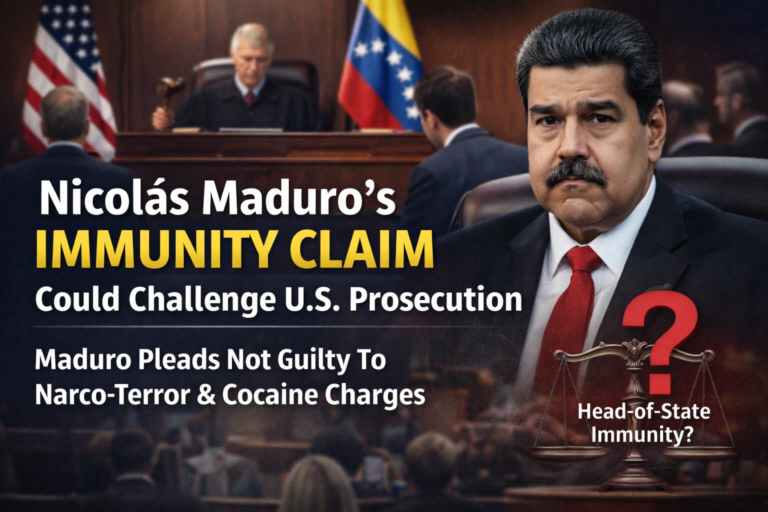
































































































































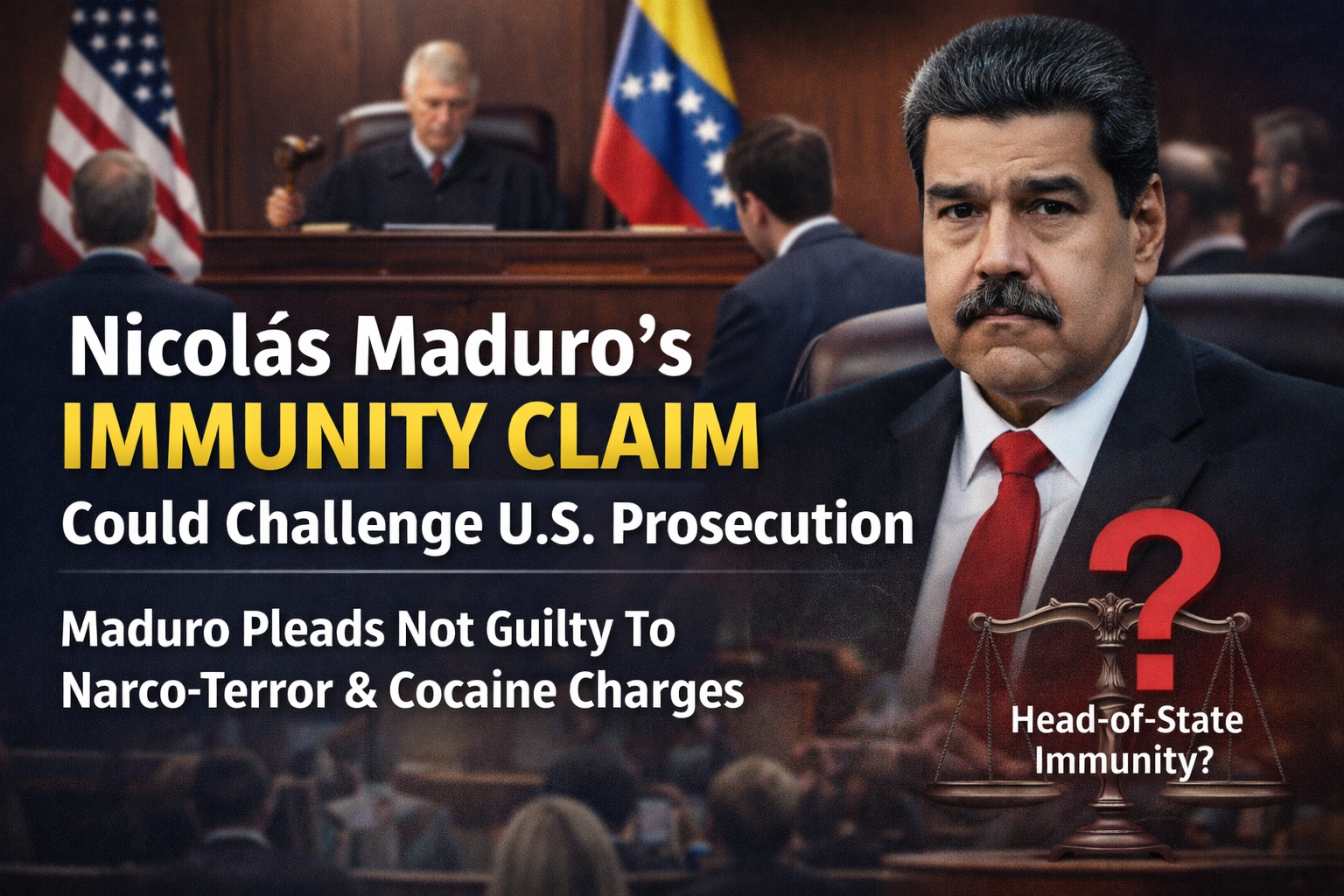
The prosecution of former Venezuelan President Nicolás Maduro in the United States has entered a complex legal phase, with his claim of sovereign immunity potentially posing a challenge for U.S. prosecutors handling narco-terrorism and drug trafficking charges.
Maduro, who was brought to the United States following a dramatic capture by U.S. forces in Caracas, appeared in a federal courtroom in Manhattan, New York, where he pleaded not guilty to charges including narco-terrorism, cocaine trafficking and conspiracy. He maintains that he remains the legitimate president of Venezuela — a stance that his defense team argues entitles him to immunity as a head of state under international law.
Immunity Question at the Heart of the Case
At the core of the legal dispute is whether Maduro can invoke head-of-state immunity to shield himself from prosecution in the U.S. Traditionally, heads of state enjoy broad immunities from criminal jurisdiction in foreign courts. However, U.S. authorities counter that Maduro is not recognized as Venezuela’s legitimate president — a position the U.S. government has held since the disputed 2018 Venezuelan election. If Maduro’s presidency is no longer recognized, the immunity argument weakens significantly.
Legal experts note that similar claims have been tested in past cases, such as the 1989 prosecution of former Panamanian leader Manuel Noriega, whose attempt to claim immunity was ultimately rejected by U.S. courts. In that case, Noriega was convicted of drug trafficking and other offenses despite his claim that he was a head of state.
Defense Strategy and Legal Challenges
Maduro’s defense — led by high-profile attorney Barry Pollack — is expected to argue both the legitimacy of Maduro’s immunity claim and the legality of his capture by U.S. forces. Pollack has characterized the capture as a “military abduction” and a violation of international norms. Prosecutors, on the other hand, argue that even if the method of capture were questionable, U.S. courts still have jurisdiction to try Maduro on his charges.
Wider Legal and Geopolitical Implications
The case is likely to have broader implications beyond the immediate prosecution, touching on international law, sovereign immunity, and U.S. extraterritorial jurisdiction. The outcome may hinge on whether the U.S. government’s refusal to recognize Maduro’s leadership disrupts his claim to head-of-state protections. Should the immunity issue proceed to higher appeals, the matter could ultimately reach federal appeals courts or even the Supreme Court.
Meanwhile, Maduro’s initial court appearance underscored his defiance, with the former Venezuelan leader and his wife both entering not-guilty pleas and asserting his continued legitimacy as the country’s president. Strained conditions and complex diplomatic factors are expected to extend the legal proceedings over several months.